Supplies:
- Peat
- Washed sand (you can get this from any hardware store, make sure to rinse it well before use)
- Rocks
- Window screen mesh
- Drill
- PVC Pipe cut to a bit shorter than your container
- Waterproof container WITHOUT drainage holes (a plastic bucket or planter would work well, though I have mine in a halved whiskey barrel)
Process:
1. Pick a spot where your bog will live. This will be its long term home, as they are very heavy to move. Carnivorous plants like as much sun as they can possibly get, so the hottest, sunniest spot in your garden is a good choice.
2. Fill the bottom of your container with clean rocks or chunks of concrete to create a reservoir and fill up some of the volume.
3. Cut a mesh screen to the right size and place it over the rock layer to prevent your substrate from muddying your reservoir. Window screen mesh works well for this.
4. Drill some small holes in your PVC pipe. This will allow water to gently seep out into the substrate.
5. Place the PVC pipe down one side of your container so the bottom is in contact with the mesh. This is how you will water your bog without disturbing your plants’ root systems too much.
6. Fill the rest of your container with a 50/50 mix of peat and coarse sand. Leave about 1-1.5 inches of room between the substrate and the top of your container.
7. Drill a small hole in the side of your container just at the top of your substrate level, and cover it with a scrap of mesh. This is your overflow hole to make sure your plants aren’t flooded.
8. Arrange your plants with a good amount of space between them. Make sure your taller plants won’t crowd out your lower-growing ones!
9. Water your bog via the PVC pipe. Don’t be afraid to use lots of water, the overflow hole will take care of that.
Things to know:
-Bog plants are adapted to very acidic, nutrient-poor environments. Fertilizing them can actually do damage.
-Your bog is going to look sad in the winter because everything goes dormant. It’s just a fact of bogs! The plants will come back in the springtime.
-Racoons and squirrels sometimes like to dig in bog containers. If they are doing that, you can cover it with a chicken wire screen until your plants get more established.
-Many bog plants have shallow root systems so try not to disturb them too much.
-You will need to weed out other plants (grass etc) that try to establish in the container once in a while. However, leave any moss that starts to grow because it is good for retaining water on hot days.
-You can trim back dead leaves and traps in early spring to allow the new growth to get at the sunlight.
Recommended native Canadian plants for an outdoor bog container:
- Labrador Tea (Ledum groenlandicum)
- Bog Cranberry (Vaccinium oxycoccos)
- Bog Rosemary (Andromeda polifolia)
- King’s Scepter Gentian (Gentiana sceptrum)
- Purple Pitcher Plant (Sarracenia purpurea)
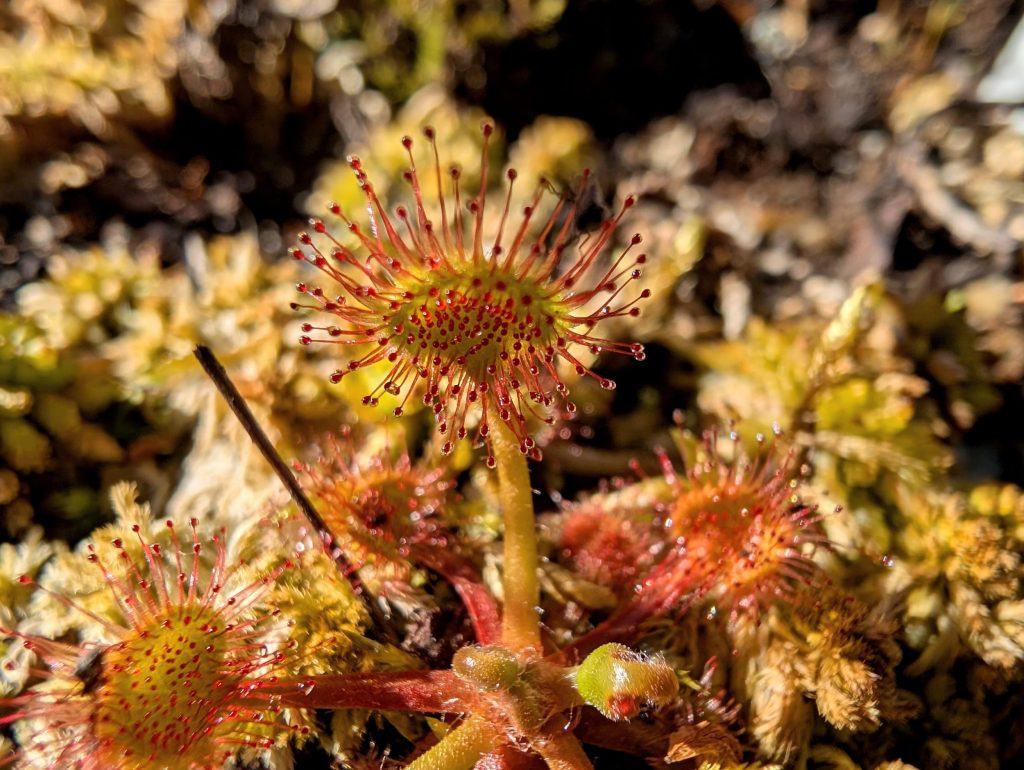
- Round-leaf Sundew (Drosera rotundifolia)
- Great Sundew (Drosera anglica)
- Horned Butterwort (Pinguicula macroceras)
- Common Butterwort (Pinguicula vulgaris)
- Western False Asphodel (Triantha occidentalis)
- Live sphagnum moss (Sphagnum spp.)
 UNLAWNING
Leave a comment